
Hyundai · Car Modules
Hyundai BCM / Smart Junction Box & DCT-TCM Module Repair
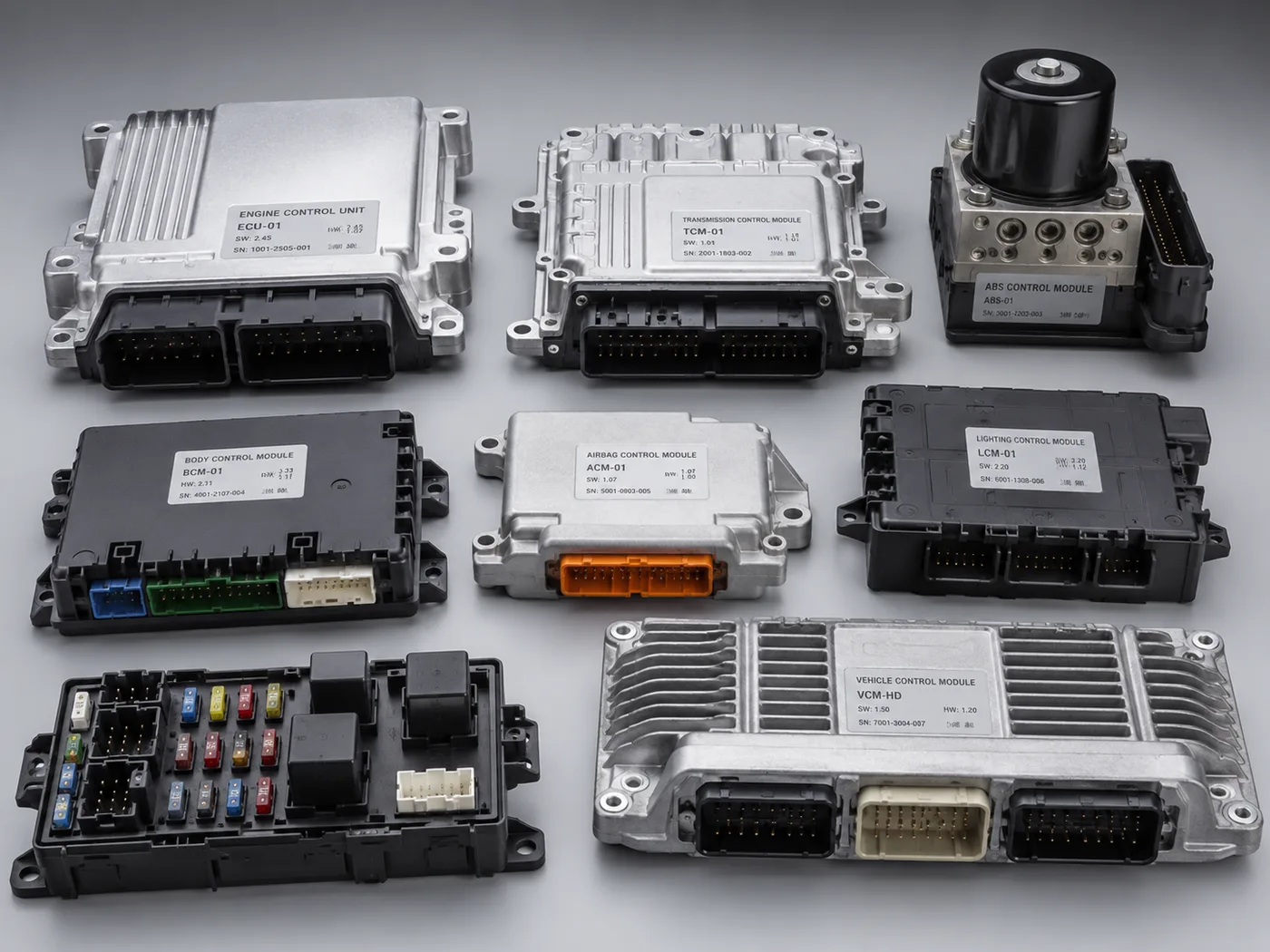
The most common electronic failure point across the modern Hyundai lineup is the Body Control Module (BCM), also called the Smart Junction Box (SJB) or fuse box on many models — it’s the central hub for lighting, locks, wipers, and battery management, and it fails often enough that it has its own well-documented repair history. Hyundai’s 7-speed dual-clutch transmission (DCT) models add a second common failure point: the Transmission Control Module (TCM). We repair both at the component level.
- ★ Google reviews
- Component-level repair
- 30-day warranty
- Mail-in across Canada
At a glance
- Service
- Hyundai BCM / Smart Junction Box and DCT-TCM Module
- Common symptoms
- Dead or draining battery overnight with no other explanation, Headlights, interior lights, or turn signals behaving erratically (including turn signals flashing the wrong direction), Power windows or door locks not responding, or locks cycling on their own
- Turnaround
- Diagnosis first; repairs that need parts ordered typically take 2 weeks to 2 months — we confirm the timeline with your quote
- Warranty
- 30-day warranty after repair
- How
- Mail-in from anywhere in Canada · free quote
What Is the BCM / Smart Junction Box?
The SJB/BCM sits in the fuse box and acts as the central relay and switching hub for the car’s body electronics — it receives signals from switches (headlights, windows, wipers) and distributes power accordingly, while also managing the “sleep mode” that lets the battery rest overnight. On DCT-equipped models, the TCM is a separate module that controls clutch engagement and shift logic.
- BCM / Smart Junction Box (Elantra, Sonata, Tucson, Santa Fe, Veloster, Accent)
- Body Control Module — earlier platforms (Tucson, Santa Fe up to ~2012)
- 7-Speed DCT Transmission Control Module (Elantra, Veloster, Tucson, Kona with dual-clutch transmission)
Why does the Hyundai BCM / Smart Junction Box and DCT-TCM module fail?
Most failures trace back to water intrusion, parasitic battery drain, and software glitches.
- Water Intrusion – the SJB/BCM lives in the fuse box; moisture tracks in and leaves green or white corrosion on the connector pins.
- Parasitic Battery Drain – a BCM that fails to enter sleep mode keeps drawing current after the car is shut off, draining the battery overnight.
- Software Glitches – documented factory software faults (e.g. the SJB turn-signal logic issue behind NHTSA recall 21V749000 on 2015-2017 Sonata) can leave a module misbehaving even when the hardware is fine.
- Voltage Spikes / Jump-Starting – can corrupt module memory and crash the board.
- DCT Clutch Overheating (TCM) – heavy stop-and-go driving heat-soaks the DCT, and the TCM logic that manages clutch engagement can fault or need a parameter update.
- Solder/Component Wear – internal relay and driver circuits degrade with age and heat cycling.
Warning signs of a failing Hyundai BCM / Smart Junction Box and DCT-TCM module
The most common signs are dead or draining battery overnight with no other explanation; headlights, interior lights, or turn signals behaving erratically (including turn signals flashing the wrong direction); and power windows or door locks not responding, or locks cycling on their own.
- Dead or draining battery overnight with no other explanation
- Headlights, interior lights, or turn signals behaving erratically (including turn signals flashing the wrong direction)
- Power windows or door locks not responding, or locks cycling on their own
- Wipers activating randomly or not parking correctly
- No-start or intermittent no-crank condition
- Multiple unrelated warning lights on the dash at once
- DCT models: shudder, hesitation, delayed acceleration from a stop, or harsh/erratic shifting (TCM)
If you’re seeing any of the above, mail your module in for diagnosis — don’t pay for a full dealer replacement first.
How we repair the Hyundai BCM / Smart Junction Box and DCT-TCM module
- Diagnostic testing to confirm module failure vs. wiring/water-leak fault
- EEPROM/data recovery and reprogramming to factory settings
- Component-level repair of damaged relays, drivers, and circuits
- Bench testing to verify full functionality before return
- Plug-and-play return — cloned to your original VIN/immobilizer data where applicable
Why send your Hyundai module to ECU Repair Doctor?
- Component-level repair, not just a fault-code reset
- Cloned to your VIN — no dealer programming visit required in most cases
- Clear timeline after diagnosis — repair time depends on parts
- Mail-in service, anywhere in Canada
- 30-day warranty on every repair
Which Hyundai models are covered?
- Hyundai Elantra (incl. DCT models)
- Hyundai Sonata
- Hyundai Tucson (incl. DCT models)
- Hyundai Santa Fe
- Hyundai Veloster / Veloster N (DCT)
- Hyundai Accent
- Hyundai Kona (DCT models)
Hyundai BCM / Smart Junction Box and DCT-TCM Module: frequently asked questions
What are the symptoms of a failing Hyundai BCM / Smart Junction Box and DCT-TCM Module?
Common signs include dead or draining battery overnight with no other explanation; headlights, interior lights, or turn signals behaving erratically (including turn signals flashing the wrong direction); power windows or door locks not responding, or locks cycling on their own; wipers activating randomly or not parking correctly. If you see these, have the module tested before paying for a dealer replacement.
What causes Hyundai BCM / Smart Junction Box and DCT-TCM Module failure?
The most common causes are water intrusion; parasitic battery drain; software glitches; voltage spikes / jump-starting.
Can the Hyundai BCM / Smart Junction Box and DCT-TCM Module be repaired instead of replaced?
Yes, in most cases. We repair the original module at the component level, so it keeps its VIN and immobilizer data and goes back in plug-and-play. If it can't be saved, we can clone your data onto a replacement unit.
Which models do you cover?
Hyundai Elantra (incl. DCT models), Hyundai Sonata, Hyundai Tucson (incl. DCT models), Hyundai Santa Fe, Hyundai Veloster / Veloster N (DCT), Hyundai Accent, Hyundai Kona (DCT models). Call or text 647-784-9939 if your model isn't listed.
How do I send my module in?
Get a free quote by phone, text or the contact form, then pack the module in an anti-static bag with padding and mail it to 76 Sherry Road, Unit H, Scarborough, ON M1L 2J9. We diagnose it first; repairs that need parts ordered typically take 2 weeks to 2 months, and we confirm the timeline with your quote. Every repair has a 30-day warranty.
Last updated October 2026
Don’t replace your Hyundai module — repair it.
Most failed modules can be repaired for a fraction of the dealer replacement price, and come back cloned to your vehicle so there’s no extra programming visit.