
Dodge · Car Modules
Dodge TIPM (Totally Integrated Power Module) Repair
The single most common electrical failure on 2007-and-up Dodge vehicles is the TIPM — the Totally Integrated Power Module. We repair TIPMs at the component level instead of selling you a full replacement.
- ★ Google reviews
- Component-level repair
- 30-day warranty
- Mail-in across Canada
At a glance
- Service
- Dodge TIPM (Totally Integrated Power Module)
- Common symptoms
- Intermittent no-crank / no-start, often worse when the engine is cold, Fuel pump not priming, or continuing to run after the engine is shut off (draining the battery), Engine cranks but won't start, acting like it's out of fuel
- Turnaround
- Diagnosis first; repairs that need parts ordered typically take 2 weeks to 2 months — we confirm the timeline with your quote
- Warranty
- 30-day warranty after repair
- How
- Mail-in from anywhere in Canada · free quote
What Is the TIPM?
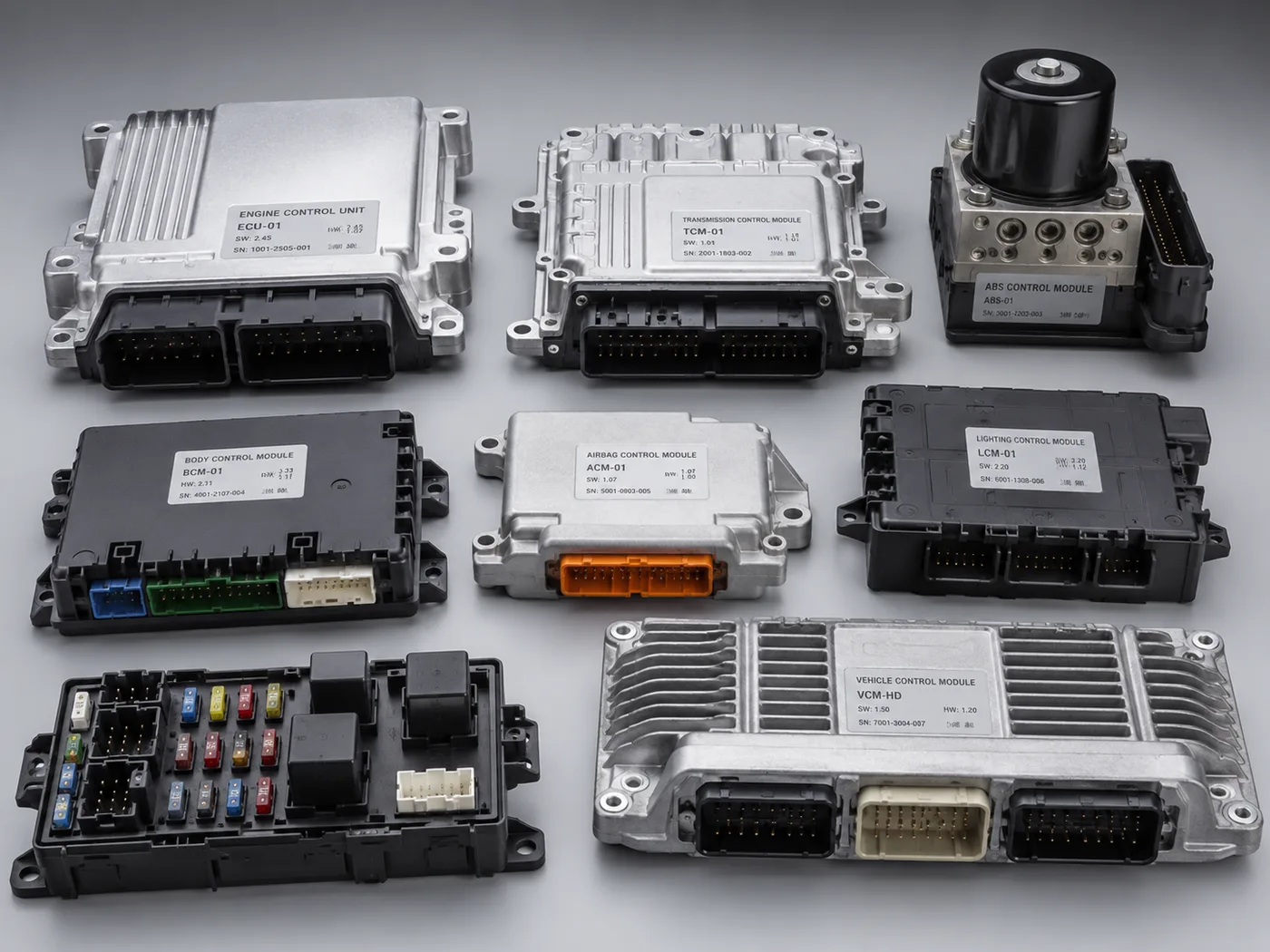
The TIPM combines the fuse box, relay center, and body control module into one unit, mounted in the engine bay next to the battery. It controls the fuel pump relay, starter relay, horn, wipers, exterior lighting, and central locking. Because the fuel pump relay is soldered directly onto the TIPM’s circuit board with no separate socket, a failed relay can’t be swapped like a normal part — the whole board needs component-level repair.
Why does the Dodge TIPM (Totally Integrated Power Module) fail?
Most failures trace back to fuel pump relay burnout, cracked solder joints, and driver transistor failure.
- Fuel Pump Relay Burnout – heat from neighboring high-current circuits cooks the relay contacts on the TIPM’s circuit board over time.
- Cracked Solder Joints – repeated heat cycling fatigues the solder around the relay legs and connector pins until connections fail intermittently.
- Driver Transistor Failure – the transistor that switches the fuel pump relay coil fails shorted or open, cutting power to the pump.
- Water Intrusion – the TIPM’s under-hood location exposes it to moisture and road spray over the vehicle’s life.
- Voltage Spikes – jump-starting or a failing alternator can damage internal components and corrupt module memory.
Warning signs of a failing Dodge TIPM (Totally Integrated Power Module)
The most common signs are intermittent no-crank / no-start, often worse when the engine is cold; fuel pump not priming, or continuing to run after the engine is shut off (draining the battery); and engine cranks but won’t start, acting like it’s out of fuel.
- Intermittent no-crank / no-start, often worse when the engine is cold
- Fuel pump not priming, or continuing to run after the engine is shut off (draining the battery)
- Engine cranks but won’t start, acting like it’s out of fuel
- Horn honking on its own or not working at all
- Wipers running continuously or not at all
- Headlights, interior lights, or turn signals malfunctioning
- Power door locks cycling on their own
- “Invalid SKIM Key” or similar security warning on the dash
These symptoms are documented across 2007-2021 Chrysler, Dodge, Jeep, and RAM models — mail your TIPM in for diagnosis before paying for a full dealer replacement.
How we repair the Dodge TIPM (Totally Integrated Power Module)
- Diagnostic testing to confirm TIPM failure vs. wiring or fuel-system fault
- Component-level repair of the fuel pump relay circuit, solder joints, and driver transistors
- EEPROM/data recovery and reprogramming to factory settings
- Bench testing to verify full functionality before return
- Plug-and-play return — cloned to your original VIN/SKIM data where applicable
Why send your Dodge module to ECU Repair Doctor?
- Component-level repair, not just a fault-code reset
- Cloned to your VIN — no dealer programming visit required in most cases
- Clear timeline after diagnosis — repair time depends on parts
- Mail-in service, anywhere in Canada
- 30-day warranty on every repair
Which Dodge models are covered?
- Dodge Charger
- Dodge Challenger
- Dodge Durango
- Dodge Journey
- Dodge Grand Caravan
- Dodge Dart
Dodge TIPM (Totally Integrated Power Module): frequently asked questions
What are the symptoms of a failing Dodge TIPM (Totally Integrated Power Module)?
Common signs include intermittent no-crank / no-start, often worse when the engine is cold; fuel pump not priming, or continuing to run after the engine is shut off (draining the battery); engine cranks but won't start, acting like it's out of fuel; horn honking on its own or not working at all. If you see these, have the module tested before paying for a dealer replacement.
What causes Dodge TIPM (Totally Integrated Power Module) failure?
The most common causes are fuel pump relay burnout; cracked solder joints; driver transistor failure; water intrusion.
Can the Dodge TIPM (Totally Integrated Power Module) be repaired instead of replaced?
Yes, in most cases. We repair the original module at the component level, so it keeps its VIN and immobilizer data and goes back in plug-and-play. If it can't be saved, we can clone your data onto a replacement unit.
Which models do you cover?
Dodge Charger, Dodge Challenger, Dodge Durango, Dodge Journey, Dodge Grand Caravan, Dodge Dart. Call or text 647-784-9939 if your model isn't listed.
How do I send my module in?
Get a free quote by phone, text or the contact form, then pack the module in an anti-static bag with padding and mail it to 76 Sherry Road, Unit H, Scarborough, ON M1L 2J9. We diagnose it first; repairs that need parts ordered typically take 2 weeks to 2 months, and we confirm the timeline with your quote. Every repair has a 30-day warranty.
Last updated October 2026
Don’t replace your Dodge module — repair it.
Most failed modules can be repaired for a fraction of the dealer replacement price, and come back cloned to your vehicle so there’s no extra programming visit.